
Short answer: Therapists use TranscribeGo to turn their own dictated voice notes into clean, structured text — so a SOAP or DAP progress note that used to take 15 minutes of typing becomes a 60-second voice memo. Dictate after each session from WhatsApp, Telegram, or the web, get an accurate transcript plus an AI summary in minutes, and set voice reminders for follow-ups. Done ethically — documenting your own clinical impressions, with client consent for anything involving session content. There's a free tier to test it, plus paid plans for regular use.
Documentation is quietly burning therapists out. Clinicians now average 13.5 hours per week on documentation — a 25% increase over the past seven years, according to Therapy Companion's analysis of charting workloads. Behavioral health clinicians spend roughly one to two hours on documentation for every hour of direct patient care, per Eleos Health. And the human cost is steep: over 93% of behavioral health clinicians report burnout symptoms, with administrative work — not caseload size or compassion fatigue — identified as the leading driver (PIMSY EHR).
The notes still have to get written. But the act of typing them — late at night, between sessions, in the gaps that should be rest — is the part that breaks people. This article shows how therapists use TranscribeGo to move that work from keyboard to voice, ethically and without adding another heavy platform to their practice.
A Note on Ethics First
This matters more in therapy than almost any other field, so let's be clear before anything else.
TranscribeGo is a transcription tool. The ethical, recommended way for a therapist to use it is to dictate your own notes — your clinical observations, assessment, and plan — as a voice memo after a session, and let the tool turn your speech into text. You are documenting your professional impressions, in your words. Nothing about the client's session needs to be recorded for this to work.
If you ever want to record or transcribe actual session audio, that is a different decision entirely, and it requires informed client consent, compliance with your jurisdiction's laws, and adherence to your professional body's ethics code (APA, BACP, your state licensing board, and so on). Progress notes and private psychotherapy notes should also be kept separate — personal impressions and countertransference belong in a different document with stronger protections, as clinical documentation guides emphasize. TranscribeGo does not make those decisions for you, and it is not a substitute for a HIPAA-covered EHR. Use it for the dictation step; keep the client record in your compliant system of record.
With that established, here's the workflow.
Why Voice Dictation Beats Typing for Therapy Notes
The math is simple. Therapists typically spend 12 to 15 minutes writing a single progress note, which adds up to 1.5 to 2 hours of charting across a normal day of sessions (Therapy Companion). Speaking is roughly three times faster than typing for most people, and crucially, it lets you capture a note immediately after a session — while the clinical picture is still fresh — instead of reconstructing six sessions from memory at 9pm.
You already think out loud about your clients. Dictation simply captures that thinking and hands it back to you as editable text.
Speak in Your Own Format
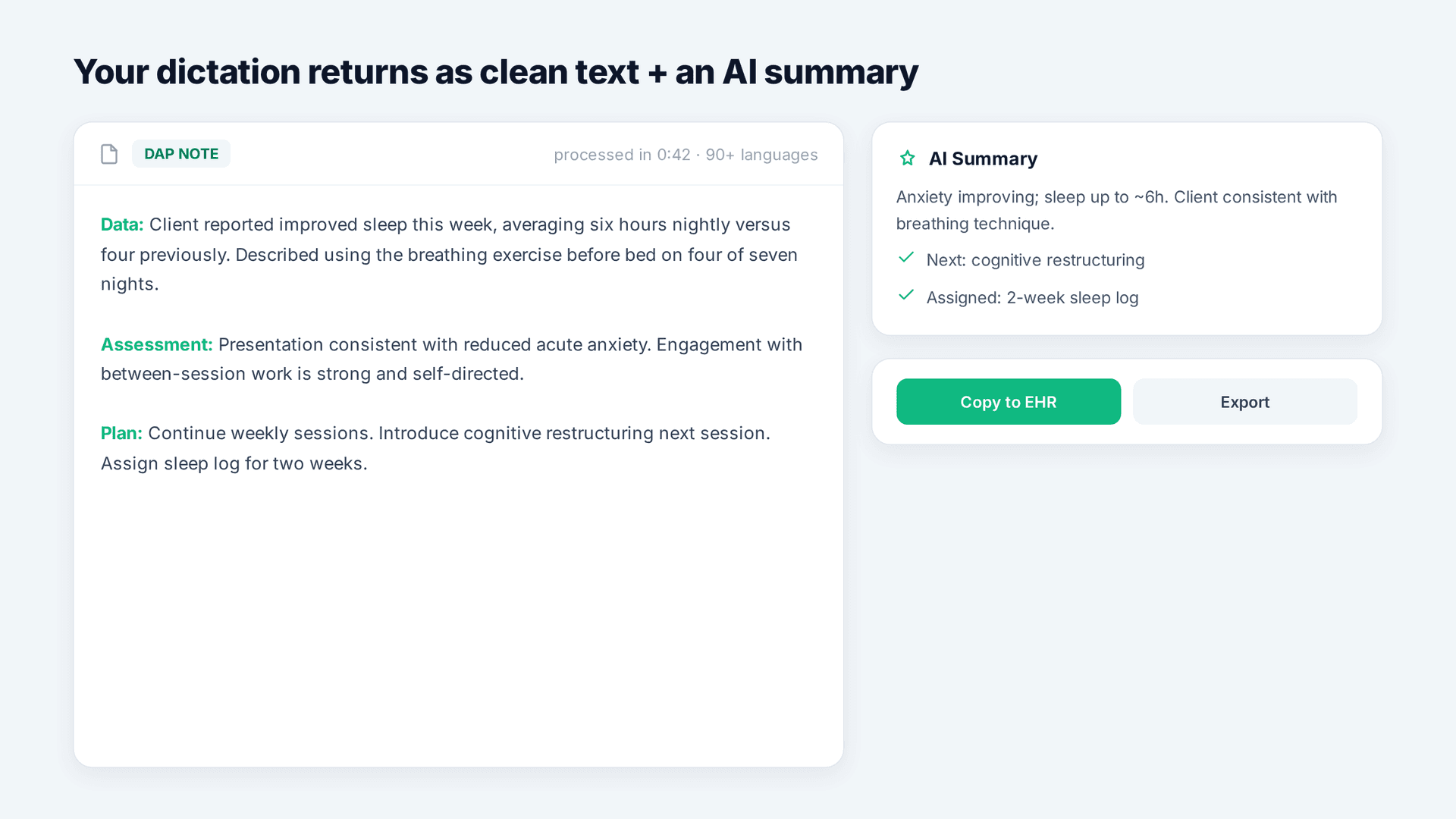
Most outpatient therapists use SOAP (Subjective, Objective, Assessment, Plan) or DAP (Data, Assessment, Plan) notes. DAP, in particular, suits the narrative style of private-practice counseling (Ditto Transcripts comparison). Because you're dictating freely, you can simply speak the sections aloud — "Data: client reported... Assessment: presentation consistent with... Plan: continue weekly, assign..." — and the transcript preserves your structure exactly. No template lock-in, no clicking through fields.
Capture the Note While It's Fresh
Best practice in clinical documentation is to record only what actually happened — not interventions you didn't use or observations you didn't make (Behave Health documentation guide). Accuracy degrades with delay. A 60-second voice memo in the two minutes between clients captures far more faithful detail than a note written hours later.
The TranscribeGo Workflow for Therapists
Here's how a private-practice therapist actually uses it, day to day.
Step 1: Dictate Your Note From Anywhere
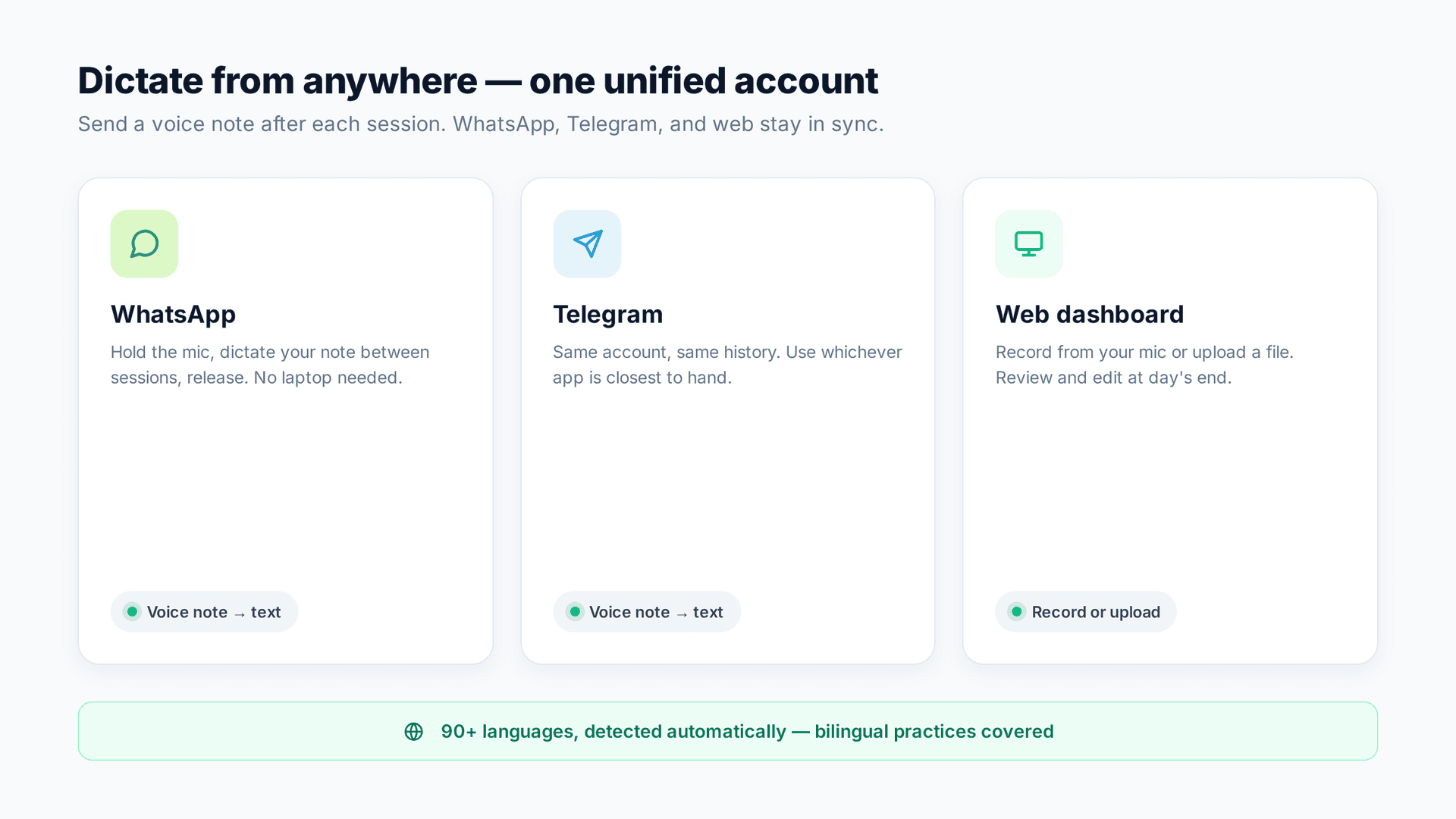
TranscribeGo works across three channels on one unified account — WhatsApp, Telegram, and the web dashboard. After a session, open whichever you have closest:
WhatsApp or Telegram: Send a voice note to the TranscribeGo bot — exactly like sending a voice message to a friend. Hold the mic, dictate your note, release. This is ideal between sessions: no laptop, no app-switching, just your phone. The same account works on both WhatsApp and Telegram, so your team or your own devices stay in sync.
Web: Record directly from your microphone at transcribego.com, or upload an audio file if you dictated into your phone's recorder.
It supports 90+ languages with automatic detection, so bilingual practices are covered without changing any settings.
Step 2: Get a Clean Transcript and an AI Summary
Within minutes, your spoken note comes back as clean, punctuated text. A typical post-session dictation processes in well under a minute. Alongside the full transcript, TranscribeGo's AI technology generates a concise summary highlighting the key points — useful when you're reviewing a client's history before their next appointment and don't want to re-read ten full notes.
The transcript is yours to copy into your EHR, your encrypted notes system, or wherever your compliant client record lives. TranscribeGo handles the speech-to-text step; you keep control of the record.
Step 3: Set Reminders by Voice — The Quiet Superpower
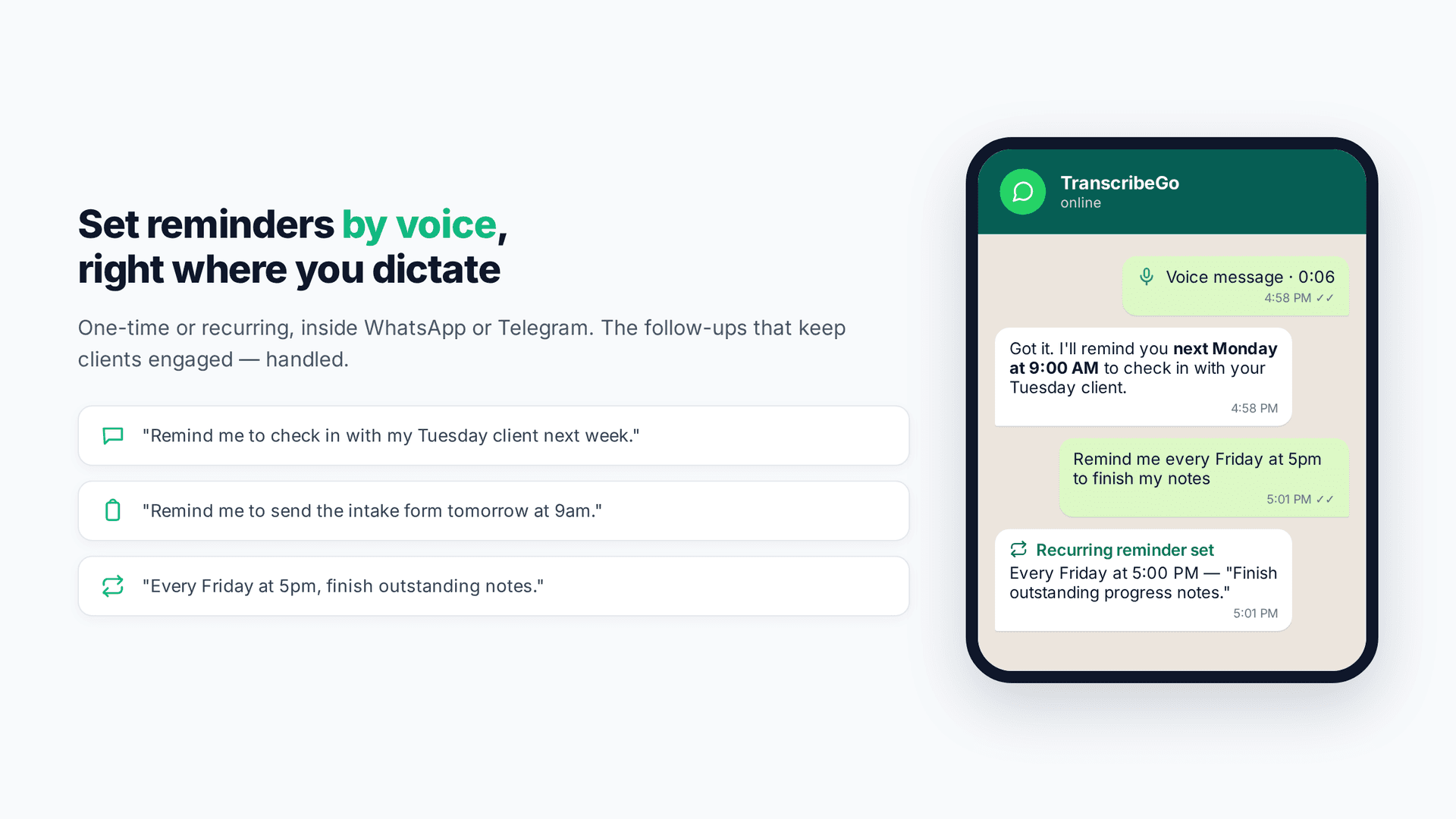
This is the feature therapists don't expect and end up using daily. TranscribeGo lets you set reminders by voice or text, right inside WhatsApp or Telegram, one-time or recurring. You just say what you need:
- "Remind me to check in with the Tuesday 4pm client about their medication change next week."
- "Remind me to send the intake form to the new client tomorrow at 9am."
- "Recordame llamar a la obra social el lunes a las 10."
- "Remind me every Friday at 5pm to finish outstanding progress notes."
For a profession where follow-through is clinical care — checking in, completing notes, preparing for the next session — having reminders live in the same place you already dictate is genuinely useful. And it connects to a real problem: outpatient therapy no-show rates run 20% to 30%, far higher than general medicine (Curogram), while automated reminders are shown to reduce missed appointments by 20% to over 50% (Blueprint). Use TranscribeGo's reminders for your own clinical to-dos and prep, and you stay on top of the follow-ups that keep clients engaged.
Beyond Notes: The Full Toolkit
Therapists reach for TranscribeGo first for dictation, but the platform does more, and it's all on the same account:
Translation, one click. Turn a transcript into any of 90+ languages instantly. Practical for multilingual practices, supervision across borders, or providing a client a summary in their first language (with appropriate consent and care).
URL transcription. Paste a YouTube, TikTok, or Vimeo link to transcribe it — handy for turning a training webinar, a conference talk, or a CE lecture into searchable notes you can actually study from.
SRT subtitle export. If you create psychoeducational videos or run online workshops, export clean SRT subtitle files to make your content accessible.
Searchable web dashboard. Everything you dictate is stored and searchable at transcribego.com. Looking for that note where a client first mentioned a specific stressor? Search your archive instead of scrolling.
Multi-channel, one account. WhatsApp, Telegram, and web all feed the same history. Dictate on your phone between sessions, review and edit on your laptop at the end of the day.
A Realistic Day With TranscribeGo
Between sessions (60 seconds each): Open WhatsApp, dictate your DAP note while the session is fresh, release. Move on to your next client.
Voice reminder (10 seconds): "Remind me to email the referral letter for the 2pm client tomorrow morning." Done — you won't forget, and you didn't break stride.
End of day (10 minutes): Open the web dashboard. Your dictations are waiting as clean transcripts with summaries. Review, lightly edit, and copy each into your EHR. The work that used to eat your evening is mostly already written — in your own words.
Weekly (recurring reminder): Every Friday at 5pm, a reminder nudges you to clear any outstanding notes before the weekend. Documentation never piles up.
The goal isn't to automate clinical judgment — that stays entirely yours. The goal is to delete the typing tax on work you're already doing in your head, so the documentation burden stops being the thing that follows you home.
Try TranscribeGo Free
10 free minutes. No credit card required.
Frequently Asked Questions
Is it ethical to use TranscribeGo for therapy notes?▾
Yes, when used appropriately. The recommended use is dictating your own clinical notes — your observations, assessment, and plan — and letting TranscribeGo transcribe your speech. You are documenting your own professional impressions, which is standard practice. What requires extra care is recording or transcribing actual client session audio: that needs informed client consent, compliance with your local laws, and adherence to your professional ethics code. TranscribeGo is a transcription tool for the dictation step, not a replacement for your compliant clinical record system.
Can I dictate SOAP or DAP notes directly?▾
Yes. Because you dictate freely, you simply speak the sections aloud — for a DAP note, say "Data:", then your observations, then "Assessment:" and "Plan:". The transcript preserves your structure exactly, with no template to fight. DAP's narrative style is especially well suited to spoken dictation in private practice, and SOAP works the same way.
How much time can dictation actually save me?▾
Therapists typically spend 12 to 15 minutes typing a single progress note, totaling 1.5 to 2 hours of charting per day. Speaking is roughly three times faster than typing, and dictating immediately after a session means you capture more accurate detail in less time. Many clinicians cut their daily documentation time substantially — the bigger win is often capturing notes while they're fresh rather than reconstructing them late at night.
Is TranscribeGo HIPAA compliant? Can I store client records in it?▾
TranscribeGo is a transcription tool, not a HIPAA-covered electronic health record. Treat it as the dictation step: use it to convert your spoken notes into text, then move that text into your compliant EHR or encrypted system of record, which is where the client record should live. For anything involving identifiable client information, follow your jurisdiction's privacy laws and your professional body's guidance, and keep psychotherapy notes separate from progress notes as required.
How do voice reminders help in a therapy practice?▾
You can set reminders by voice or text inside WhatsApp or Telegram — one-time or recurring — for your own clinical to-dos: following up with a client, sending an intake form, completing outstanding notes, or preparing for a session. Say "Remind me to check in with my Tuesday client about their medication next week" and it's set. Since outpatient no-show rates run 20–30% and reminders are shown to cut missed appointments significantly, staying on top of your follow-ups directly supports client engagement.
Which TranscribeGo plan fits a private-practice therapist?▾
There's a free tier to test dictation with a few notes, plus Starter and Pro plans for regular use. Because each dictated note is usually under a minute, a solo practice with a steady dictation habit fits comfortably in a lower tier, while higher-volume practices — or those who also transcribe webinars, supervision recordings, or longer dictations — are better served by a higher tier. Every plan includes reminders, translation, URL transcription, and access across WhatsApp, Telegram, and web on one account. For the current plans and pricing in your country, see transcribego.com.
This article is for informational purposes and does not constitute legal, ethical, or clinical advice. Therapists are responsible for ensuring their documentation practices comply with applicable privacy laws and their professional body's ethics code. If you're navigating documentation-related stress or burnout, consider reaching out to a supervisor, peer consultation group, or your professional association for support.